
Richard Hourican |
A party wall is a shared wall, structure or boundary feature that may be protected by the Party Wall etc. Act 1996. If you are planning building works in London, understanding whether the Act applies is essential before works begin. Hourican Associates are Specialist Party Wall Surveyors in London, providing notices for the proposed notifiable works, Schedule of Condition Surveys, Party Wall Awards and practical advice for homeowners, adjoining owners, architects and developers.
What Is a Party Wall?
A party wall is generally a wall or structure shared by two or more owners. The most common example is the dividing wall between two terraced or semi-detached houses. Party walls can also exist in flats, commercial buildings, townhouses and mixed-use properties where separate owners share structural elements.
The Act recognises two main types of party wall:
-
Party Wall Type A: A wall that stands astride the boundary of land belonging to two or more different owners. This may:
- Form part of one building, such as the dividing wall in a terraced house.
- Separate two or more buildings.
- Include a party fence wall, which is a masonry wall used to divide land but is not part of a building. This does not include a timber fence.
- Party Wall Type B: A wall that stands wholly on one owner’s land but is used by two or more owners to separate their buildings.
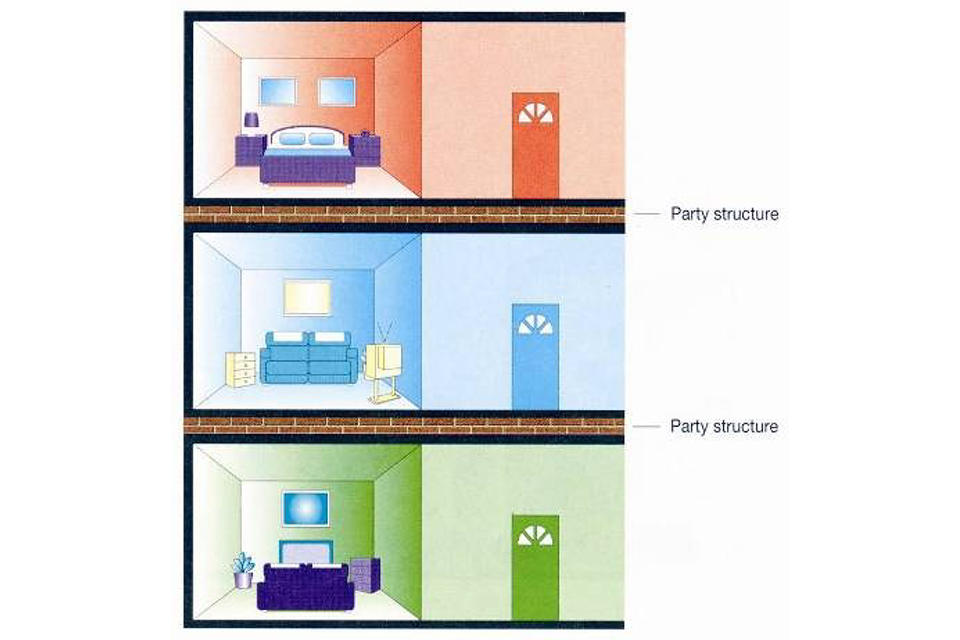
The Act also refers to a party structure. This may include walls, floors, partitions or other separating structures between different parts of a building, such as flats or maisonettes with separate entrances or staircases.
Walls that are not usually party walls include:
- Boundary walls built wholly on one owner’s land.
- External walls built up to, but not astride, the boundary.
- Ordinary timber garden fences.
Diagram 1
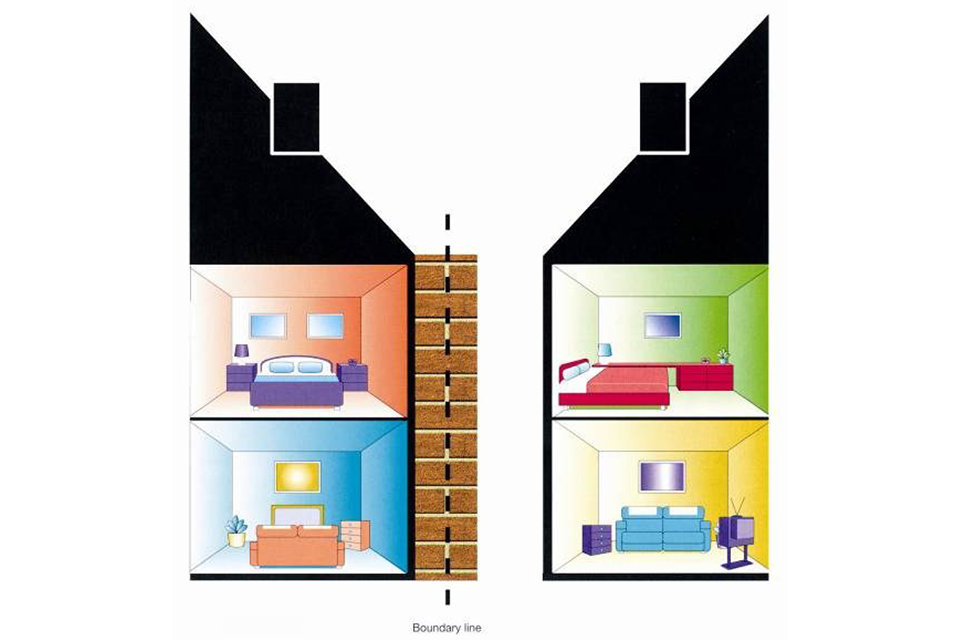
Diagram 2
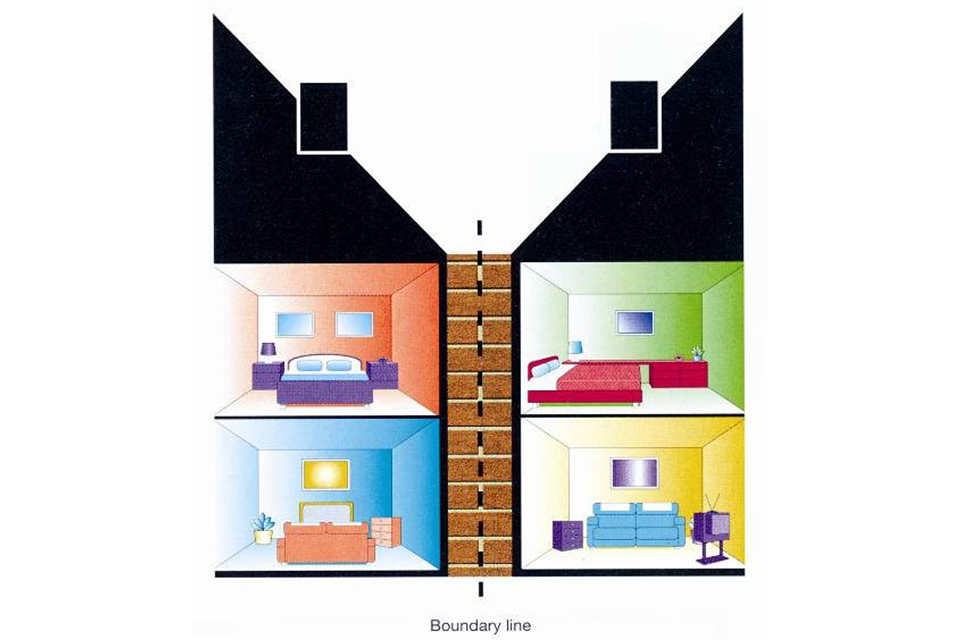
Diagram 3
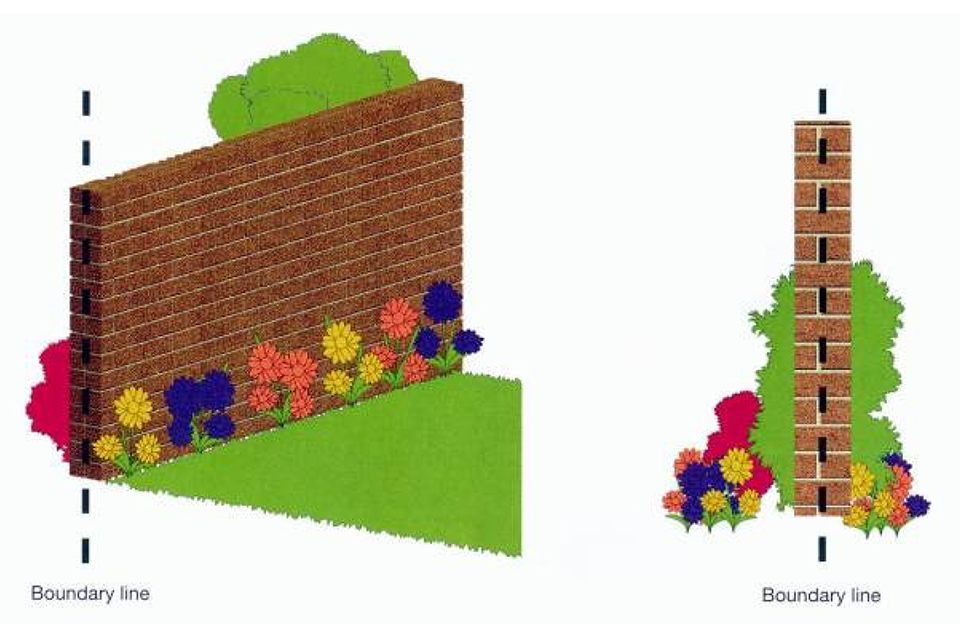
Diagram 4
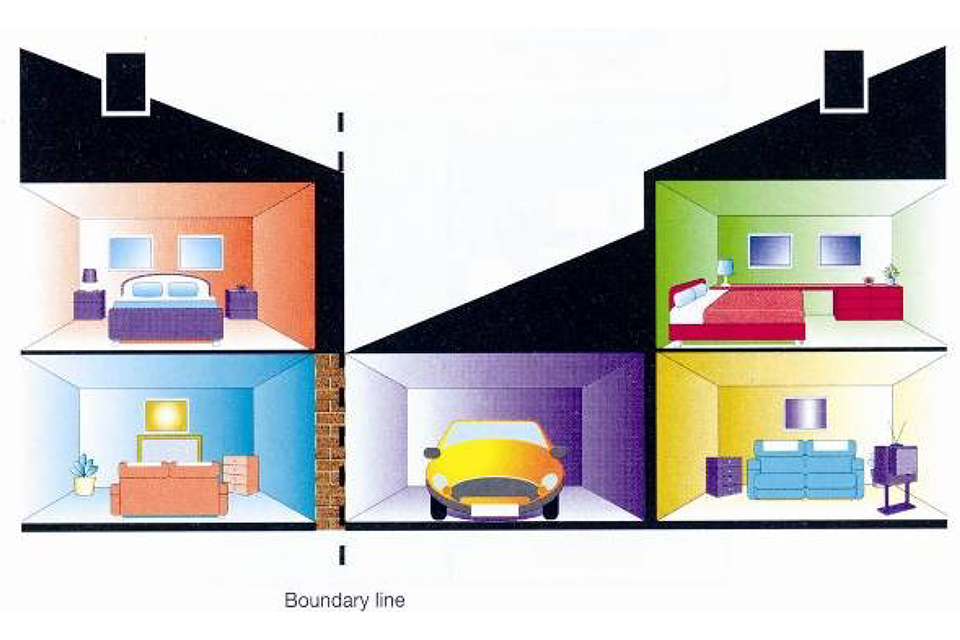
Diagram 5
When Does the Party Wall Act Apply?
You may need to comply with the Party Wall etc. Act 1996 if your proposed works affect a shared wall, structure, boundary or nearby foundations. Common examples include:
- Building on or at the boundary line, including certain new walls or boundary works.
- Cutting into a party wall, for example to insert steel beams for a loft conversion.
- Raising, thickening, underpinning or altering a party wall.
- Removing chimney breasts from a party wall. See our party wall chimney removal service.
- Excavating within 3 metres or 6 metres of a neighbouring structure where the proposed excavation may be deeper than neighbouring foundations. See our party wall excavation survey service.
- Constructing a basement or carrying out deeper structural works. See our party wall survey service for basement works in London.
- Building a rear extension close to a neighbouring property. See our party wall survey service for rear extensions.
If you are unsure whether your works are notifiable, it is sensible to seek advice before speaking to your neighbour or starting construction. You can also read our guide: Do I need a party wall agreement?
How Does the Party Wall Process Work?
The party wall process is designed to make sure building owners can carry out lawful works while protecting adjoining owners from unnecessary risk. The exact route depends on the type of works, the notices required and how the adjoining owner responds.
-
Initial review of the proposed works
A party wall surveyor reviews your drawings, structural proposals and property layout to identify whether the works fall under the Act. -
Serving the correct Party Wall Notice
The building owner serves the relevant notice on each adjoining owner. Hourican Associates provide a Party Wall Notice Service in London for building owners who need notices prepared and served correctly. -
Adjoining owner response
The adjoining owner may consent, dissent and appoint their own surveyor, or dissent and agree to use one impartial agreed surveyor. Read more about the agreed surveyor role. -
Schedule of Condition Survey
Where appropriate, the neighbouring property is inspected and recorded before works begin. This is often one of the most useful protections for both parties. See our Schedule of Condition Survey service. -
Party Wall Award
If there is a dissent, the appointed surveyor or surveyors prepare a Party Wall Award. This sets out how the works may proceed, including access, protection, working methods and responsibilities. -
Works proceed in accordance with the Award
Once the process is complete and the relevant notice periods have expired or been agreed, works can proceed in line with the Award and the Act.
Example Party Wall Timeline
Every project is different, but the example below shows how a typical London residential party wall process may progress.
| Stage | Typical Timing | What Happens |
|---|---|---|
| Design and advice | Before notices are served | Your drawings and proposals are reviewed to confirm which sections of the Act apply. |
| Party Wall Notice prepared | Usually once drawings are sufficiently detailed | The correct notice is prepared for each adjoining owner, depending on the works. |
| Notice served | At least 1 or 2 months before notifiable works, depending on the notice type | Section 1 and Section 6 notices generally require one month. Section 2 party structure notices generally require two months. |
| Adjoining owner response period | Usually 14 days | The adjoining owner can consent, dissent, appoint their own surveyor, or agree to use one agreed surveyor. |
| Surveyor appointment | If dissent arises | The building owner and adjoining owner appoint surveyors, or both owners appoint one agreed surveyor. |
| Schedule of Condition | Before works begin | A written and photographic record of the adjoining owner’s property is prepared. |
| Party Wall Award agreed | Before notifiable works begin | The Award confirms how the works may proceed and records rights, responsibilities and protective measures. |
| Works commence | After the process is complete | Works proceed in accordance with the Award, the served notices and any agreed conditions. |
This is an indicative timeline only. Complex works, basement schemes, multiple adjoining owners, absent owners or disputed designs can extend the process.
Why Are Party Wall Agreements Important?
A properly handled party wall process helps reduce confusion, protect neighbouring properties and create a clear framework for the works. It is particularly important in London where terraced houses, flats, extensions, basements and boundary works are common.
Party wall agreements and Awards can help to:
- Prevent disputes through clear documentation.
- Protect both parties with a Schedule of Condition.
- Define access rights, working hours and responsibilities.
- Reduce legal risks if damage is alleged.
- Give owners, architects and contractors a clear route for compliance.
Risks of Not Using a Qualified Party Wall Surveyor
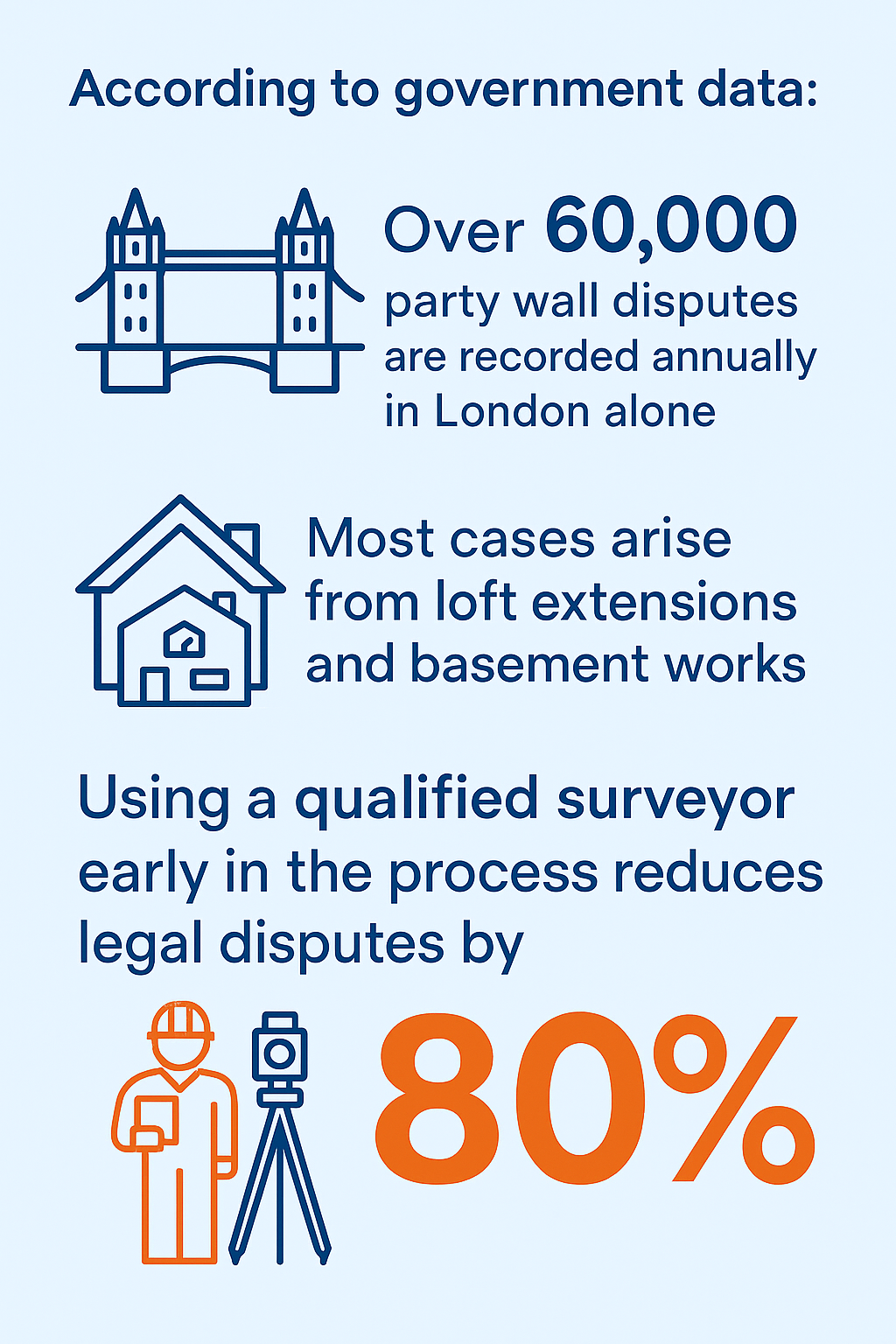
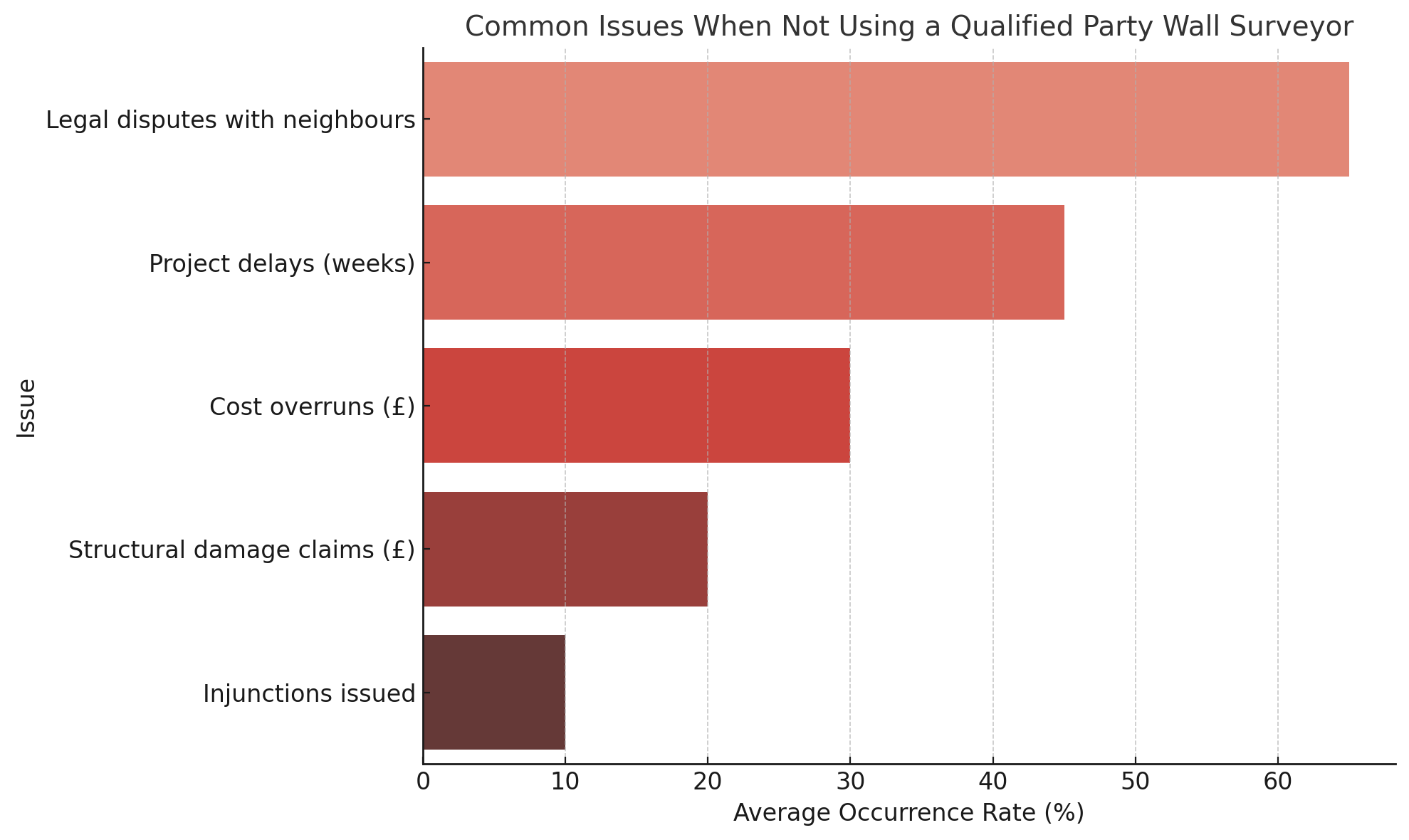
Not appointing a qualified party wall surveyor, or using incorrect notices, can lead to avoidable delay, cost and neighbour disputes. The table below gives indicative examples of the types of problems that can arise when the process is not handled correctly.
| Potential Issue | Illustrative Risk Level | Possible Additional Cost or Impact |
|---|---|---|
| Legal disputes with neighbours | High | Professional fees, legal advice and project disruption |
| Project delays | Medium to high | Programme delays, contractor standing time and rescheduling costs |
| Incorrect or invalid notices | Medium | Notices may need to be re-served, delaying the start of notifiable works |
| Damage disputes | Medium | Arguments over whether damage existed before works began |
| Injunction risk | Project dependent | Works may be paused while legal issues are addressed |
This is why it is important to seek professional guidance from a suitably qualified practice such as Hourican Associates.
The following chart visually illustrates common risks and potential impacts when notifiable party wall matters are not dealt with properly:
Who Are Hourican Associates?
Hourican Associates are a Chartered Building Consultancy specialising in party wall surveying throughout London. We advise building owners and adjoining owners across residential and commercial projects, from simple notices to complex basement and structural works.
- Chartered Building Consultancy specialising in Party Wall matters.
- RICS-regulated firm and Chartered Building Consultancy.
- Richard Hourican's supplied qualifications and memberships are MFPWS, BSc (Hons), MCIOB, MCABE and AssocRICS. His Pyramus & Thisbe Society membership is company-supplied, pending a current membership record.
- Experienced across North, South, East and West London.
- Trusted by homeowners, architects, developers and adjoining owners.
We can act as the Building Owner’s Surveyor, the Adjoining Owner’s Surveyor, or as an impartial agreed surveyor where both owners wish to keep the process simpler and more cost-effective.
Why Choose Hourican Associates?
- Party Wall Notice Service: from £150 + VAT per adjoining owner.
- Schedule of Condition Surveys: typically £385–£585 + VAT, depending on the works and size of the property.
- Full Party Wall Award Service: typically £1,100–£1,500 + VAT, depending on the property, project size and complexity.
- Basement works priced separately where required: basement surveys can involve more detailed inspection of the full property and more complex structural considerations.
- London-wide coverage: including North London, South London, East London and West London.
- Local area expertise: including Chiswick, Fulham, Chelsea, Kensington, Camden, Islington and surrounding areas.
Frequently Asked Questions
Yes, you may need a party wall agreement if your extension involves building on the boundary, excavating close to your neighbour’s property, or altering a shared wall. If you are unsure whether your works are notifiable, read our guide on whether you need a party wall agreement or speak to a surveyor before works begin.
Yes, a loft conversion often requires notice if you are cutting into the party wall for steel beams, raising the party wall, altering the roof structure, or carrying out other works that affect the shared wall. See our loft conversion party wall service.
Costs vary depending on the project and the number of adjoining owners. Hourican Associates’ typical fees are:
- Party Wall Notice Service: from £150 + VAT per adjoining owner.
- Schedule of Condition Survey: typically £385–£585 + VAT, depending on works and property size.
- Full Party Wall Award Service: typically £1,100–£1,500 + VAT, depending on property and project complexity.
Basement surveys may be priced separately because they can involve more detailed inspection of the whole property.
If your neighbour dissents or does not respond within the statutory period, a dispute arises under the Act. Surveyors must then be appointed to agree a Party Wall Award. Your neighbour may appoint their own surveyor, or both owners may appoint one impartial agreed surveyor.
A Party Wall Award is a legally binding document that sets out the works, access arrangements, protection measures, timings and responsibilities of the parties. It enables notifiable works to proceed lawfully once the party wall dispute has been resolved.
A Schedule of Condition is a photographic and written record of the adjoining owner’s property before works begin. It helps protect both owners if a damage dispute arises later.
If you excavate within 3 metres of a neighbouring structure and the excavation will go deeper than your neighbour’s foundations, you may need to serve a Section 6 notice. Excavations within 6 metres may also be notifiable in certain circumstances where deeper excavation and foundation angles are involved.
No. If the works are notifiable under the Act, starting without serving the correct party wall notice can lead to legal action, an injunction, delay, increased costs and potential damage claims.
Yes. Both owners can appoint one impartial agreed surveyor. This can make the process simpler and more cost-effective, provided both parties are comfortable with a single surveyor acting impartially under the Act.
Need Expert Party Wall Advice in London?
Whether you are a homeowner planning an extension, a developer preparing for basement works, or an adjoining owner who has received a notice, understanding the role of a party wall is essential. With guidance from Hourican Associates, you can approach your project with confidence, compliance and peace of mind.
We provide Party Wall Notices, Schedule of Condition Surveys, Party Wall Awards, dispute resolution and specialist advice across London.
Request a Free Party Wall Quote NowNo-obligation consultations with Party Wall surveyors | Prompt London-wide service
Useful resources:
- Party Wall Surveyor Services
- Party Wall Notices London
- Party Wall Awards London
- Schedule of Condition Surveys London
- Party Wall Dispute Resolution
- Party Wall Frequently Asked Questions
Data sources and references:
- Party Wall etc. Act 1996 – www.legislation.gov.uk
- Surveyor insight based on London residential party wall matters and Hourican Associates’ professional experience.
- Indicative project risk examples are for general guidance only and should not be treated as formal statistical or legal evidence.
Disclaimer: All cost estimates are indicative only and may vary depending on the nature, scale and location of your project. Legal obligations under the Party Wall etc. Act 1996 should always be confirmed with a qualified party wall surveyor. For formal advice, we recommend booking a consultation.