
Richard Hourican |
Searching for a Party Wall Notice template UK can be a sensible first step, but the template is only useful if it matches your exact building works, property ownership and neighbour situation.
A Party Wall Notice is not just a neighbourly letter. It is a formal notice under the Party Wall etc. Act 1996. If the wrong notice is served, the details are incomplete, the timing is wrong, or the adjoining owner is not correctly identified, the process may be delayed and the notice may need to be served again.
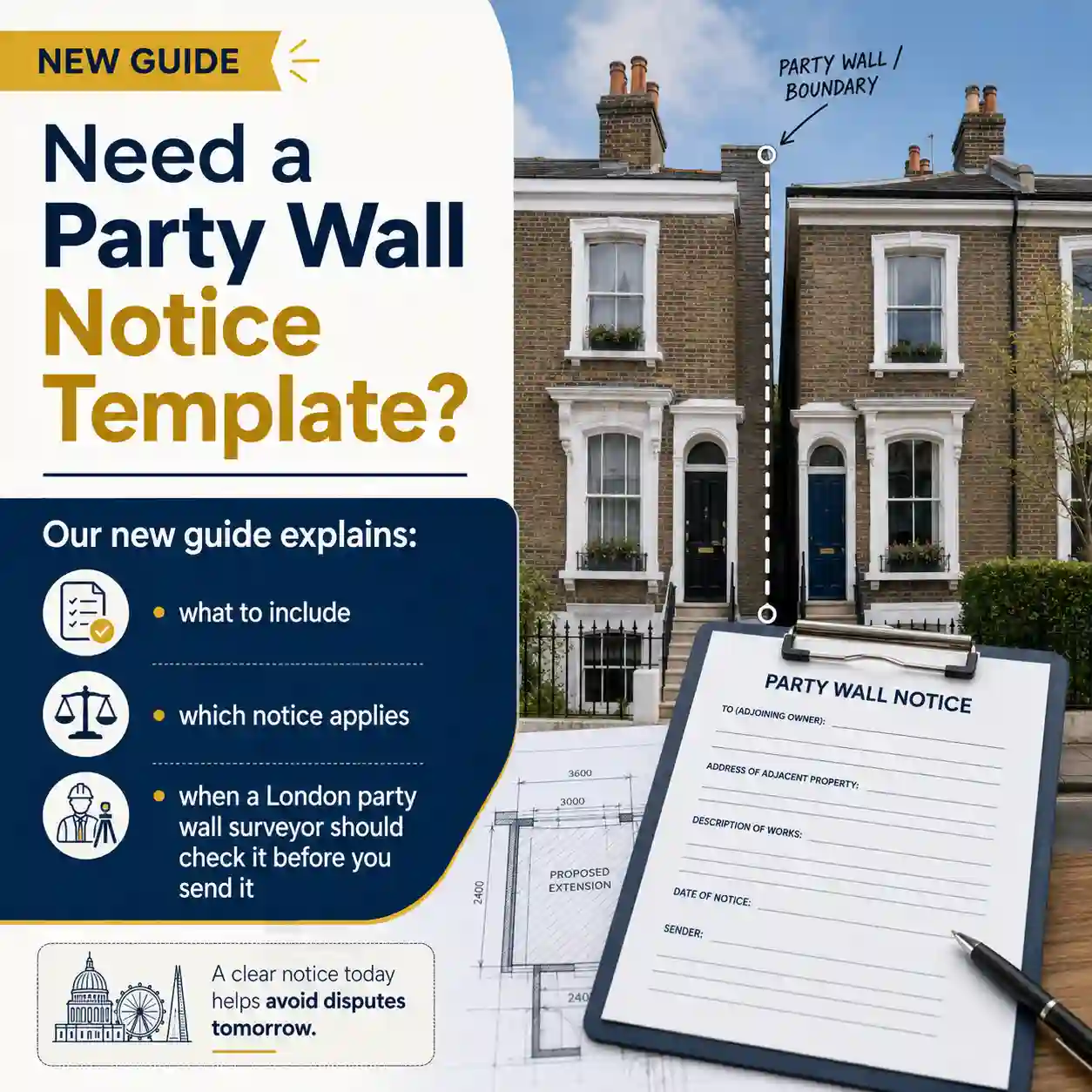
This guide explains what a Party Wall Notice template should include, the main notice types, where homeowners often go wrong, and when it is worth asking a London party wall surveyor to check the notice before it is sent.
Quick Answer: What Should a Party Wall Notice Template Include?
A Party Wall Notice template should usually include the building owner’s full name and address, the adjoining owner’s details where known, the address where the works are proposed, a clear description of the works, the relevant section of the Act, the planned start date, and enough drawings or structural information for the adjoining owner to understand what is being notified.
The most important point is that there is no single universal Party Wall Notice template for every project. A rear extension, loft conversion, chimney breast removal, boundary wall or excavation may each need a different notice, and some projects need more than one.
Party Wall Notice Template or Party Wall Agreement Template?
Homeowners often search for a “party wall agreement template” when they actually need a Party Wall Notice. The two are not the same.
A Party Wall Notice is the formal document served by the building owner before certain notifiable works begin. It tells the adjoining owner what is proposed and gives them the opportunity to consent or dissent.
A Party Wall Agreement is a general phrase people often use to describe the outcome of the process. In many cases, where there is a dissent or no response, the formal document that authorises the works is a Party Wall Award, not a simple agreement letter.
If you are at the start of your project, you probably need to check whether a notice is required first. If there is already a dispute or dissent, you may need a Party Wall Award. Hourican Associates can help with both Party Wall Notices in London and Party Wall Awards in London.
The Three Main Types of Party Wall Notice
The correct notice depends on the work, not simply on the name of the project. A loft conversion, extension or refurbishment can involve different parts of the Act depending on the design.
1. Line of Junction Notice
This notice is commonly relevant where a new wall is proposed at or astride the boundary line between two properties. It often arises with side extensions, rear extensions, garden walls and boundary wall construction.
If your project involves a new wall at the boundary, read our guide to Party Wall Section 1 and the Line of Junction.
2. Party Structure Notice
This notice is commonly relevant where works affect an existing party wall, party fence wall or party structure. It is often triggered by cutting into a party wall for steel beams, raising a party wall, removing a chimney breast, inserting flashings, or altering a shared structural element.
This is especially common in London loft conversions and internal structural refurbishments. See our Party Wall Loft Conversion London and Party Wall Chimney Removal London pages for project-specific guidance.
3. Notice of Adjacent Excavation
This notice is commonly relevant where excavation is proposed near a neighbouring structure and below certain foundation levels. It often arises with extensions, basements, new foundations and drainage works.
If your project involves foundations or deeper excavation, read our guide to Party Wall Section 6 Excavation Notices.
Party Wall Notice Template Checklist
Before sending a Party Wall Notice, check that your draft includes the core information needed to make the notice clear and useful.
- Building owner details: the full legal name and correspondence address of the owner proposing the works.
- Adjoining owner details: the neighbour’s correct name and address where known.
- Property address: the address where the works are proposed.
- Relevant section of the Act: for example, line of junction, party structure works or adjacent excavation.
- Description of works: enough detail for the adjoining owner to understand what will happen.
- Proposed start date: the date when the notifiable works are expected to begin.
- Drawings or structural details: especially where excavation, steel beams, chimney works or party wall raising are involved.
- Signature and date: the notice should be properly completed and dated.
- Method of service: keep a record of how and when the notice was served.
Example Party Wall Notice Wording
The wording below is not a substitute for a professionally prepared notice, but it shows the type of information a notice usually needs to cover.
Example structure only:
Dear [Adjoining Owner Name],
I/we, [Building Owner Name], of [Building Owner Address], give notice of proposed works at [Building Owner Property Address] under the Party Wall etc. Act 1996.
The proposed works include [brief description of notifiable works, for example inserting steel beams into the party wall, excavating for new foundations, or building a new wall at the boundary].
The proposed start date for the notifiable works is [date].
Plans and/or structural details are enclosed where relevant.
In practice, the wording should be tailored to the correct section of the Act and supported by the right drawings. A generic downloaded template may not be enough if it does not describe the work accurately.
Common Mistakes with Party Wall Notice Templates
Many delays happen because a notice looks complete at first glance but fails on one of the practical details.
Using the wrong notice type
A notice for excavation is not the same as a notice for cutting into a party wall. If the wrong notice is served, the adjoining owner may not have been properly notified.
Missing an owner
In London, ownership can be complicated. There may be freeholders, leaseholders, joint owners, companies, managing agents or separate flat owners. Serving only the occupier is not always enough.
Not allowing enough time
Party Wall Notices should be served early enough to allow the statutory process to run before works begin. Leaving notices until the contractor is ready to start can create avoidable pressure and delay.
Too little detail
A vague description such as “extension works” or “loft works” may not explain what is actually being done to the wall, boundary or neighbouring structure. The adjoining owner should be able to understand the notifiable elements.
No drawings where drawings are needed
Structural drawings, sections and foundation details can be important, particularly for excavation, steel beams, padstones, underpinning, chimney works and party wall raising.
Can You Serve a Party Wall Notice Yourself?
A building owner can serve their own Party Wall Notice, but there is a difference between filling in a template and serving a notice that is correct for the works. If the project is simple, the ownership is clear and the drawings are straightforward, a template may be enough after careful checking.
For more complex London projects, a surveyor’s review can reduce the risk of delay. This is particularly useful where:
- the property is a flat, maisonette or leasehold building;
- the adjoining owner details are unclear;
- the works include steel beams or structural alterations;
- the project involves excavation near neighbouring foundations;
- more than one notice may be required;
- the neighbour has already raised concerns;
- the project is due to start soon.
What Happens After the Notice Is Served?
Once a Party Wall Notice has been served, the adjoining owner can usually consent, dissent and appoint their own surveyor, dissent and agree to use one Agreed Surveyor, or fail to respond.
If the adjoining owner consents in writing, there may be no dispute at that stage. Even then, the building owner must still carry out the works properly and avoid unnecessary inconvenience or damage.
If the adjoining owner dissents or does not respond within the relevant period, a dispute may be deemed to have arisen. That does not necessarily mean anyone is being unreasonable. It usually means the statutory surveyor process is needed before notifiable works proceed.
Where one impartial surveyor acts for both owners, this is known as the Agreed Surveyor route. Where each owner appoints their own surveyor, the two surveyors will usually agree the Party Wall Award between them.
Should You Get a Schedule of Condition?
A Schedule of Condition is often recommended where building works could later lead to concerns about cracking, movement, finishes or damage. It records the adjoining property before works begin using written notes and photographs.
It can be especially useful for loft conversions, chimney breast removals, excavation works and structural alterations. If damage is alleged later, the Schedule of Condition provides a clear baseline.
Learn more about Schedule of Condition Surveys in London.
London Project Examples Where a Template May Not Be Enough
Loft conversion with steel beams
A loft conversion may require a Party Structure Notice if steel beams are inserted into a party wall. The notice should reflect the structural drawings rather than simply saying “loft conversion”.
Rear extension with foundations
A rear extension may require excavation notices if new foundations are close to neighbouring structures and deeper than the neighbour’s foundations. It may also involve a new boundary wall notice.
Chimney breast removal
Chimney breast removal can involve cutting, support and making good to a party wall. A generic template may not cover the relevant structural details.
Basement or deeper excavation
Basement and deeper excavation works usually need more careful review because the neighbouring structure, depth, distance and method of work all matter.
Building Owner Pre-Send Checklist
Before sending a Party Wall Notice, ask:
- Have I identified the correct adjoining owner or owners?
- Have I chosen the correct notice type?
- Does the notice describe the notifiable works clearly?
- Have I included the proposed start date?
- Have I allowed enough time before works begin?
- Have I attached drawings or structural information where needed?
- Have I kept a record of service?
- Do I know what to do if the neighbour dissents or does not reply?
Need a Party Wall Notice Checked?
A template can help you understand the process, but the safest notice is one that reflects your actual project. Hourican Associates can review your drawings, confirm which notices are needed, prepare and serve Party Wall Notices, and advise on the next steps if your neighbour consents, dissents or does not respond.
For professional support, visit our Party Wall Notices London service page or contact Hourican Associates to ask us to check your proposed works.
Frequently Asked Questions

Richard Hourican, Company Director
BSc (Hons). HND Build. MCIOB. C.Build E MCABE. ARICS. MFPWS. MPTS
As a specialist Party Wall surveyor, Richard Hourican will protect your interests during building works.
Are you planning a building project – perhaps an extension, loft conversion or basement – that is on or adjacent to your property’s boundary line? Or has a ‘Party Wall’ notice dropped on the doormat informing you of a neighbour’s impending works?
It’s essential to understand all the implications of building plans. If you don’t, it could cost thousands. Our job is to ensure everything is done correctly – and that it doesn’t!
Follow us: