
Richard Hourican |
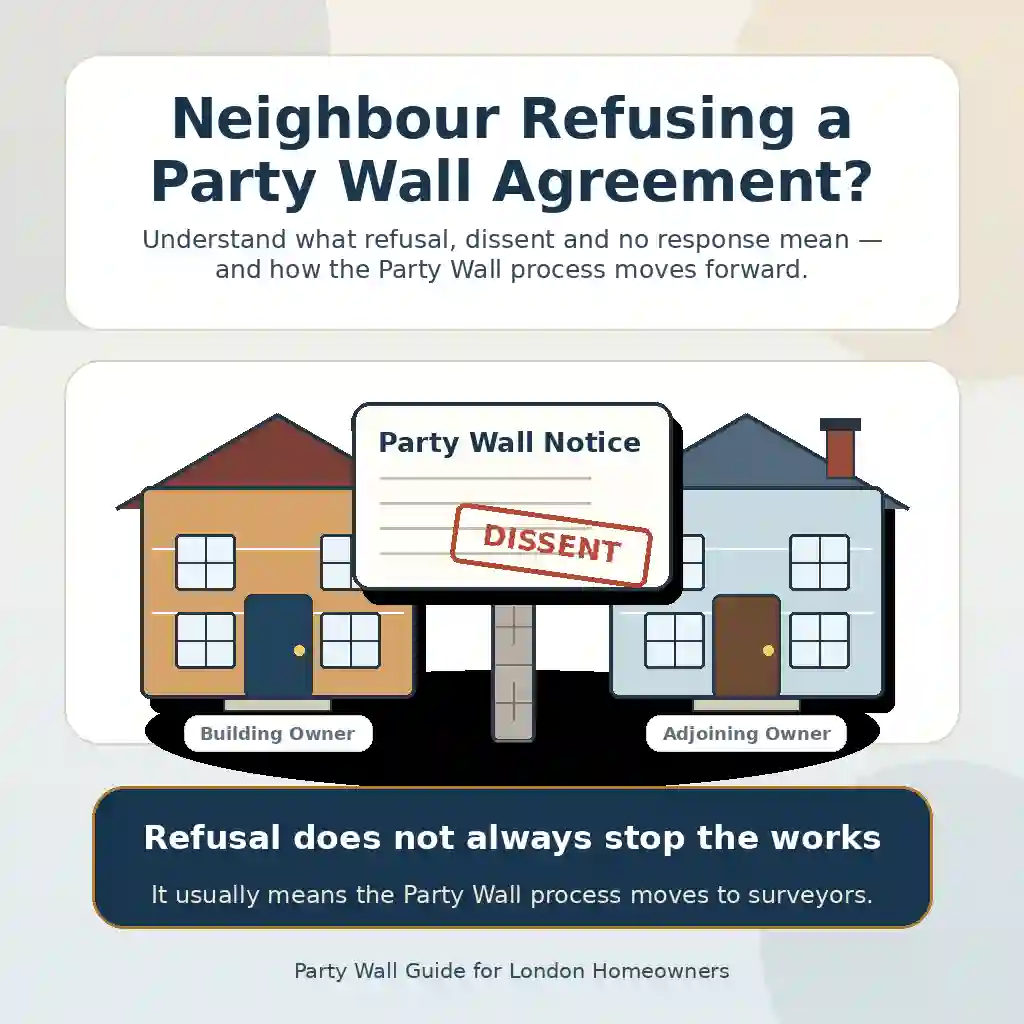
If your neighbour is refusing to sign a Party Wall Agreement, it can feel as though your building project has come to a halt. In reality, a refusal or lack of response does not always mean the works cannot proceed. In many cases, it simply means the formal dispute resolution procedure under the Party Wall etc. Act 1996 must be followed.
This guide explains what happens when a neighbour refuses a Party Wall Agreement, what “dissent” actually means, whether your neighbour can stop the works, how surveyors become involved and what practical steps building owners and adjoining owners should take next.
Need help with a refused Party Wall Agreement?
Hourican Associates are specialist Party Wall Surveyors in London. We can review your notice, advise whether the Party Wall etc. Act 1996 applies, help respond to a dissent, act as Building Owner’s Surveyor, Adjoining Owner’s Surveyor or Agreed Surveyor, and progress matters towards a Party Wall Award where required.
Can a Neighbour Refuse a Party Wall Agreement?
Yes, a neighbour can refuse to consent to a Party Wall Notice. This is normally referred to as a dissent. However, dissent does not necessarily mean the neighbour can stop the works altogether.
Under the Party Wall etc. Act 1996, many types of notifiable work are permitted provided the correct notice procedure is followed and any dispute is resolved through the statutory surveyor process. If your neighbour dissents, surveyors may need to be appointed and a Party Wall Award may be required before the notifiable works start.
It is important to understand the difference between:
- Consent — the adjoining owner agrees to the works described in the notice.
- Dissent — the adjoining owner does not consent, so the dispute resolution procedure under the Act is triggered.
- No response — for many notice types, no written reply within the required period can mean a dispute is deemed to have arisen.
- Refusal of specific consent — in some situations, such as building a new wall astride the boundary line, the adjoining owner’s written consent is required for that specific proposal.
What Does “Refusing a Party Wall Agreement” Usually Mean?
Homeowners often use the phrase “Party Wall Agreement” to describe several different things. Your neighbour may be refusing one of the following:
- consent to a Party Wall Notice;
- the appointment of one Agreed Surveyor;
- the proposed scope of works;
- access arrangements;
- working hours;
- the proposed method of construction;
- the proposed protection measures;
- or a draft Party Wall Award.
The correct next step depends on what has actually been refused. A neighbour who refuses to consent to a notice is not necessarily preventing the works. They may simply be asking for the formal protections of the Act to be put in place.
Can a Neighbour Stop the Works by Refusing to Sign?
In most standard Party Wall matters, a neighbour cannot permanently stop works simply by refusing to sign a notice. If the works are lawful and fall within the Party Wall etc. Act 1996, dissent normally leads to surveyor appointments and a Party Wall Award.
The Award sets out how the notifiable works may be carried out. It can deal with practical matters such as access, working methods, protection, timings, damage procedures, surveyor fees and the condition of the adjoining property.
However, there are important exceptions. For example, if a building owner wants to build a new party wall astride the boundary line, the adjoining owner’s written consent is generally required. If that consent is refused, the building owner may need to build wholly on their own land instead.
Why Might a Neighbour Refuse a Party Wall Agreement?
A refusal is not always unreasonable. Many adjoining owners are simply worried about risk, damage, disruption or unclear information. Common reasons include:
- concerns about cracking or movement;
- lack of drawings or structural details;
- uncertainty about excavation depth;
- worries about basement works or underpinning;
- concerns about access, scaffolding or working hours;
- previous disputes or poor communication;
- confusion between planning permission and the Party Wall Act;
- fear that consenting removes their rights;
- not understanding the notice or response options;
- or wanting a Schedule of Condition before works begin.
In many cases, a refusal can be managed constructively by providing clearer information, explaining the process and appointing a suitably experienced Party Wall Surveyor.
What Happens After a Neighbour Dissents?
Once an adjoining owner dissents to a Party Wall Notice, a dispute has arisen under the Act. This does not necessarily mean there is personal conflict between neighbours. “Dispute” is simply the legal term used to describe the situation where consent has not been given and the statutory process must be followed.
The next step is usually one of the following:
-
Both owners appoint one Agreed Surveyor
One impartial surveyor acts for the purposes of the Act and prepares the Party Wall Award. This can often be the most efficient and proportionate route for straightforward residential projects. -
Each owner appoints their own surveyor
The building owner appoints a surveyor and the adjoining owner appoints a separate surveyor. The two surveyors then agree the Party Wall Award. A third surveyor is selected in case the two appointed surveyors cannot agree. -
The adjoining owner fails to appoint
If the adjoining owner refuses or fails to appoint a surveyor after a dispute has arisen, the Act provides a mechanism for the process to continue. A second surveyor may be appointed on their behalf so that the Award process is not blocked indefinitely.
What If the Neighbour Ignores the Party Wall Notice?
If your neighbour does not reply, the effect depends on the type of notice served.
For works to an existing party wall or party structure, or for excavations within the relevant distances under the Act, no written response within the statutory period can mean a dispute is deemed to have arisen. In practical terms, this means the matter usually moves to surveyor appointment.
For some boundary-line notices, the position can be different. If the proposal involves building astride the boundary line, the adjoining owner’s written consent is needed. If they do not consent, the building owner may need to build the wall wholly on their own land.
What Is a Party Wall Award?
A Party Wall Award is the formal document prepared by the surveyor or surveyors after a dispute arises under the Act. It is often what homeowners mean when they talk about needing a “Party Wall Agreement”.
A Party Wall Award may include:
- the names and addresses of the building owner and adjoining owner;
- details of the surveyor or surveyors appointed;
- the notices served;
- drawings and structural information;
- a description of the authorised works;
- working methods and restrictions;
- access arrangements;
- protection measures;
- working hours;
- procedures for dealing with damage;
- surveyor fees;
- and, where appropriate, a Schedule of Condition.
For more detail, see our dedicated guide to Party Wall Awards in London.
Does the Neighbour Lose Their Rights by Agreeing?
No. Consent to a Party Wall Notice does not mean the adjoining owner gives up all protection. The building owner still has obligations under the Act, including avoiding unnecessary inconvenience and dealing appropriately with damage caused by notifiable works.
This is important because some neighbours refuse simply because they believe consent means they are accepting all risk. In lower-risk cases, a clear explanation, properly served notice and Schedule of Condition Survey may help reassure the adjoining owner.
Should You Try to Resolve the Refusal Informally?
Yes, where possible. Good communication can save time, cost and frustration. Before assuming your neighbour is being difficult, consider whether they have enough information to make an informed decision.
Useful steps include:
- sharing drawings and structural details in plain English;
- explaining which parts of the work are notifiable;
- confirming proposed start dates and expected duration;
- offering a Schedule of Condition Survey;
- explaining the role of an Agreed Surveyor;
- addressing practical concerns such as dust, noise, access and working hours;
- and avoiding pressure or informal promises that are not properly documented.
Friendly discussion is helpful, but any agreement should be recorded properly in writing.
When Should You Appoint a Party Wall Surveyor?
You should consider appointing a Party Wall Surveyor if:
- your neighbour has dissented to the notice;
- your neighbour has not replied within the required period;
- your neighbour refuses to appoint a surveyor;
- there is disagreement about access, working methods or protection;
- the works involve excavation, basement construction, underpinning or structural alterations;
- you are unsure whether the notice was valid;
- or you want the matter progressed correctly under the Act.
Hourican Associates can act as Building Owner’s Surveyor, Adjoining Owner’s Surveyor or Agreed Surveyor, depending on the circumstances.
What If the Refusal Is About Access?
Party Wall matters often involve practical access issues, particularly for scaffolding, protective works, inspection or making good. Some access rights may arise under the Act, but not every form of access is automatically covered.
If the dispute is really about scaffolding, hoarding, temporary protection or access to complete works neatly, it is important to identify whether the access is part of the Party Wall procedure or whether a separate agreement may be needed.
For more information, see our guide to access to a neighbour’s land for scaffolding, hoardings and safety.
What If the Neighbour Refuses Because They Think Planning Permission Is Enough?
Party Wall procedures are separate from planning permission and building regulations approval. A project may have planning permission and still require Party Wall Notices. Equally, some notifiable Party Wall works may not require planning permission.
If a neighbour refuses because they are confusing planning objections with Party Wall matters, it may help to explain that a Party Wall Surveyor does not decide whether the project should have planning permission. The surveyor deals with matters under the Party Wall etc. Act 1996, including how notifiable works are carried out and how adjoining property is protected.
Can the Works Start Before the Party Wall Issue Is Resolved?
Notifiable works should not normally begin until the correct notice process has been followed and any required consent or Party Wall Award is in place.
Starting too early can create serious problems, including neighbour complaints, delay, damage disputes and possible legal action. If a dispute has arisen, wait until the correct surveyor process has been completed and the Award has been served before starting the notifiable parts of the works.
What If My Neighbour Is Refusing Everything?
Some neighbours refuse to engage at all. They may ignore letters, decline to appoint a surveyor or object to the project in principle.
If the works are properly notifiable under the Act, the process is designed so that one party cannot normally block progress by refusing to cooperate. However, the correct procedure must be followed carefully.
This is where professional advice is particularly important. A surveyor can confirm whether the Act applies, whether the notice is valid, what appointment steps are required and how to progress the matter without invalidating the process.
Advice for Building Owners
If you are the building owner and your neighbour refuses a Party Wall Agreement, you should:
- Check that the correct Party Wall Notice was served.
- Check that all relevant adjoining owners were notified.
- Keep a record of service and responses.
- Do not start notifiable works prematurely.
- Consider whether an Agreed Surveyor may be appropriate.
- If the neighbour will not agree to an Agreed Surveyor, ask them to appoint their own surveyor.
- Take advice if they refuse to appoint or ignore further correspondence.
- Prepare drawings, structural details and access information for the surveyor process.
Advice for Adjoining Owners
If you are the neighbour being asked to sign a Party Wall Agreement, you should:
- Read the notice carefully and check what work is proposed.
- Respond in writing within the required period.
- Do not sign simply because you feel pressured.
- Ask for drawings and clarification if anything is unclear.
- Consider requesting a Schedule of Condition Survey.
- Decide whether to consent, dissent and appoint an Agreed Surveyor, or dissent and appoint your own surveyor.
- Keep communication polite and in writing.
- Take advice if works have started without proper notice.
Common Mistakes to Avoid
- Assuming refusal stops the project automatically — it often triggers the formal process instead.
- Starting works too early — this can escalate matters quickly.
- Using the wrong notice — an invalid notice can delay the project.
- Failing to notify all adjoining owners — there may be more than one legal owner.
- Confusing planning objections with Party Wall matters — they are separate regimes.
- Pressuring the neighbour to sign — this often damages trust and increases resistance.
- Assuming an Agreed Surveyor acts for the building owner — an Agreed Surveyor must act impartially under the Act.
- Failing to record the adjoining property’s condition — this can make later damage disputes harder to resolve.
How Hourican Associates Can Help
Hourican Associates are specialist Party Wall Surveyors in London. We help building owners and adjoining owners resolve Party Wall matters clearly, proportionately and in accordance with the Act.
We can assist with:
- reviewing drawings and confirming whether the Act applies;
- preparing and serving Party Wall Notices;
- checking whether a notice is valid;
- advising after a neighbour dissents or refuses to sign;
- acting as Building Owner’s Surveyor;
- acting as Adjoining Owner’s Surveyor;
- acting as Agreed Surveyor where both owners agree;
- carrying out Schedule of Condition Surveys;
- and agreeing Party Wall Awards.
Need help after a neighbour refused a Party Wall Agreement?
Send Hourican Associates your notice, drawings or neighbour response and we will advise on the next step. We can help confirm whether the Act applies, whether the notice is valid and whether a Party Wall Award is required.
Frequently Asked Questions

Richard Hourican, Company Director
BSc (Hons). HND Build. MCIOB. C.Build E MCABE. ARICS. MFPWS. MPTS
As a specialist Party Wall surveyor, Richard Hourican will protect your interests during building works.
Are you planning a building project – perhaps an extension, loft conversion or basement – that is on or adjacent to your property’s boundary line? Or has a ‘Party Wall’ notice dropped on the doormat informing you of a neighbour’s impending works?
It’s essential to understand all the implications of building plans. If you don’t, it could cost thousands. Our job is to ensure everything is done correctly – and that it doesn’t!
Follow us: