
Richard Hourican |
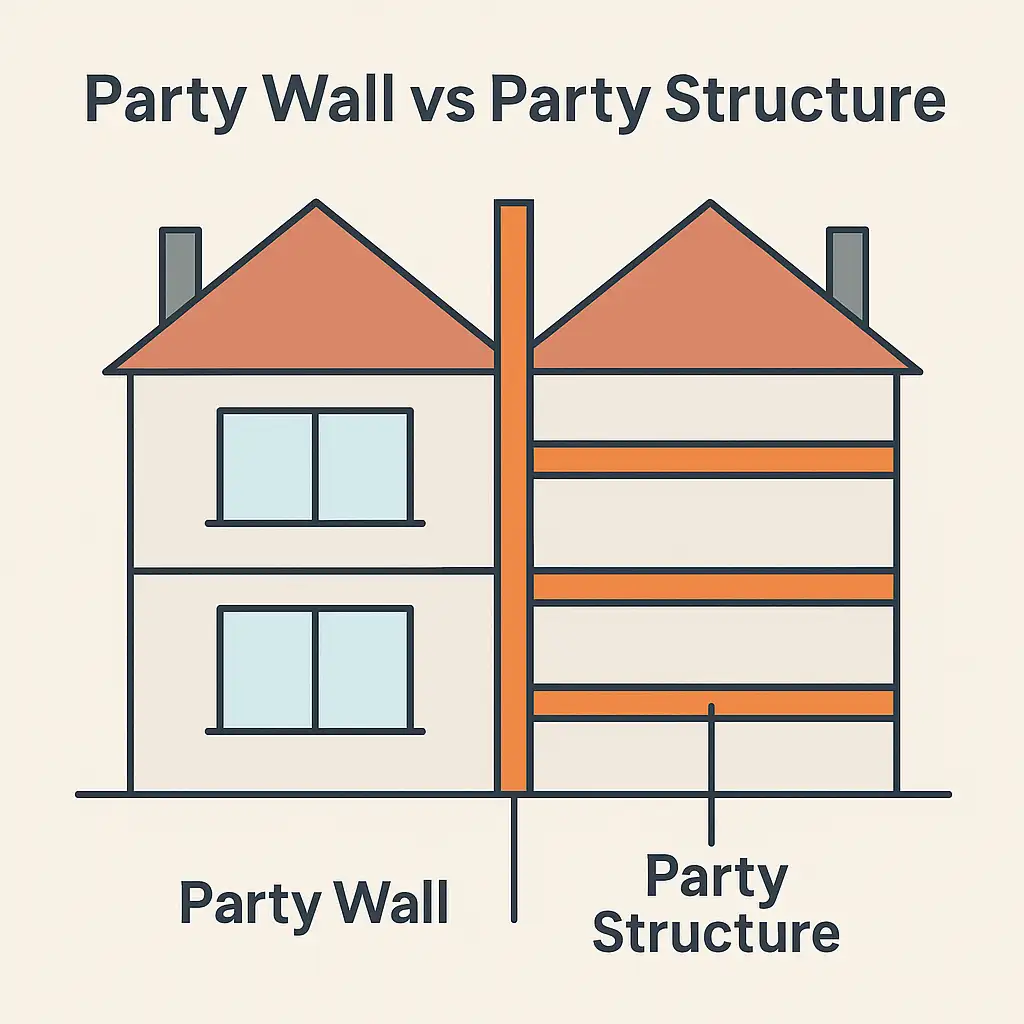
The key distinction is simple: a party wall is usually a shared vertical wall, while a party structure is broader and can include walls, floors, ceilings, partitions and other structures separating buildings or parts of buildings with separate access. Knowing which applies affects the correct notice type, the minimum notice period, whether a Party Wall Award may be required, and how the adjoining owner should respond.
Quick answer: what is a Party Structure Notice?
A Party Structure Notice is the notice served where proposed works are to an existing party wall or party structure under Section 2 of the Party Wall etc. Act 1996. The notice requirements are set out under Section 3, which is why it is often called a Section 3 Party Structure Notice.
It must usually be served at least two months before the proposed works begin. If the adjoining owner dissents or does not respond within the required period, party wall surveyors may need to be appointed and a Party Wall Award agreed before notifiable works start.
Guidance only; not legal advice. Every project is unique and must be assessed against the Party Wall etc. Act 1996, the drawings, site conditions, ownership structure and local authority requirements.
Definitions Under the Party Wall etc. Act 1996
What is a Party Wall?
A party wall is commonly a wall shared by two owners. This may be a wall built astride the boundary between two properties, or a wall that stands wholly on one owner’s land but separates two buildings belonging to different owners.
- Dividing wall between terraced houses
- Shared wall between semi-detached houses
- Wall used by two buildings to separate different ownerships
- Some masonry garden boundary walls may be party fence walls
Typical London examples: Victorian terraces, semi-detached houses, converted townhouses, mews houses and properties where one building encloses against another owner’s wall.
What is a Party Structure?
A party structure includes a party wall but is wider in scope. It can include a floor, ceiling, partition or other structure separating parts of buildings approached by separate entrances or staircases.
- Floors and ceilings between flats
- Structural partitions between separately owned units
- Shared structural elements in converted houses
- Separating structures in mixed-use or commercial buildings
Key point: party structures are not limited to vertical walls. In flats, mansion blocks and converted London buildings, floors and ceilings can be party structures too.
Party Structure Notice Explained: Section 2 and Section 3
The phrase Party Structure Notice is one of the most searched and misunderstood terms under the Party Wall etc. Act 1996. In practice, homeowners often search for a “Section 2 notice”, “Section 3 notice” or “party structure notice” when planning structural work to a shared wall or separating structure.
The distinction is important:
- Section 2 gives the building owner certain rights to carry out specific works to an existing party wall or party structure.
- Section 3 sets out the requirement to serve a formal notice before those works begin.
- That formal notice is known as a Party Structure Notice.
| Search term | What it usually means | Correct context |
|---|---|---|
| Party Structure Notice | A notice for works to an existing party wall or party structure | Notice served under Section 3 for works relying on Section 2 rights |
| Section 2 Notice | Common shorthand used by homeowners and builders | Section 2 describes the rights; the formal notice requirement sits under Section 3 |
| Section 3 Notice | Another name for a Party Structure Notice | The correct notice route for many works to existing party walls and party structures |
Hourican Associates can review your drawings and confirm whether your project requires a Party Wall Notice, a Party Structure Notice, an Adjacent Excavation Notice, a Line of Junction Notice, or a combination of notices.
When Do You Need a Party Structure Notice?
You may need a Party Structure Notice where your proposed works affect an existing party wall or party structure. This is common where the project changes the structure, thickness, height, support, bearing, stability or physical condition of a shared structure.
Common London projects that may require a Party Structure Notice
- Loft conversions: cutting pockets into a party wall to insert steel beams, padstones or structural supports. See our Party Wall Surveyor for Loft Conversions in London service.
- Chimney breast removal: cutting away or removing a chimney breast attached to a party wall. See our party wall chimney removal advice.
- Basement works: underpinning, extending a party wall downwards, strengthening a shared wall or combining Section 2 works with excavation notices. See our basement works party wall service.
- Flat alterations: works affecting a floor, ceiling or partition between separately owned flats, maisonettes or converted buildings.
- Structural openings: cutting into a party wall for beams, bearings, flashings, supports or structural alterations.
- Raising or rebuilding a party wall: for mansard lofts, roof extensions, additional storeys or structural repair works.
- Repairing, underpinning or strengthening a shared structure: where the works go beyond minor surface-level repairs.
Minor works may not need notice
Not every job involving a shared wall requires a Party Structure Notice. Minor works such as ordinary shelving, light fixings, replastering or shallow electrical chasing may fall outside the process where there is no likely structural effect. The safer test is whether the work could affect the structural strength, support function or condition of the adjoining owner’s side of the wall. If there is any doubt, get the works reviewed before starting.
Party Structure Notice Timeline
A Party Structure Notice should be served early enough to avoid project delay. The minimum statutory notice period is usually two months, but in practice you should allow additional time for checking drawings, identifying adjoining owners, neighbour responses, surveyor appointments, a Schedule of Condition Survey and agreeing the Party Wall Award if a dispute arises.
| Stage | What happens | Why it matters |
|---|---|---|
| 1. Drawing review | Surveyor checks whether the works affect a party wall, party structure, boundary or nearby foundations | Confirms the correct notice route before serving anything |
| 2. Notice preparation | Party Structure Notice is drafted with accurate ownership details, work description and proposed start date | Vague or incorrect notices can cause delay or be challenged |
| 3. Notice served | Notice is served on the adjoining owner at least two months before relevant works start | Starts the formal statutory process |
| 4. Neighbour response | The adjoining owner may consent, dissent and appoint a surveyor, or fail to respond | No response is generally treated as dissent, triggering the surveyor process |
| 5. Schedule of Condition | A written and photographic record of the adjoining property is prepared where appropriate | Protects both owners if damage is later alleged |
| 6. Party Wall Award | Surveyor or surveyors agree the method, safeguards, access, timings and responsibilities | Allows notifiable works to proceed in a controlled, legally recognised way |
Do not leave party wall matters until the week before builders are due to start. Two months is the minimum notice period for party structure works, not the full practical lead time for a smooth project.
What Should a Party Structure Notice Include?
A Party Structure Notice should be specific, accurate and clear enough for the adjoining owner to understand what is proposed. A generic description such as “loft conversion works” or “internal alterations” may not be enough if the notifiable element is actually cutting into a party wall, removing a chimney breast or raising a shared wall.
A good Party Structure Notice should usually identify:
- The building owner’s full name and address
- The adjoining owner’s correct name and address
- The property where the works are proposed
- The relevant part of the Act and the notice type
- A clear description of the notifiable works
- The proposed start date, allowing the correct notice period
- Relevant drawings, structural information or method details where helpful
- A response route for the adjoining owner to consent or dissent
- Whether an Agreed Surveyor may be considered
Better wording example
Instead of: “We are carrying out a loft conversion.”
Use a more precise description such as: “The proposed works include cutting pockets into the party wall to accommodate steel beams and padstones associated with the loft conversion, together with associated making good.”
If you are unsure whether your notice is detailed enough, Hourican Associates can prepare and serve the notice on your behalf through our Party Wall Notices in London service.
Party Structure Notice vs Other Party Wall Notices
Some projects need one notice. Others need several. For example, a basement conversion may involve excavation near neighbouring foundations and works directly to an existing party wall. A loft conversion may include cutting steel beams into a party wall and raising the party wall for a mansard roof.
| Scenario | Relevant notice | Minimum notice period |
|---|---|---|
| Cutting into a party wall for beams, padstones or structural support | Party Structure Notice for Section 2 works | 2 months |
| Removing a chimney breast from a party wall | Party Structure Notice | 2 months |
| Raising, thickening, underpinning or repairing a party wall | Party Structure Notice | 2 months |
| Works to a separating floor or ceiling between flats | May be a Party Structure Notice depending on the structure and ownership | 2 months |
| Excavation within 3m or 6m of a neighbouring structure | Adjacent Excavation Notice | 1 month |
| Building a new wall at or astride the boundary | Line of Junction Notice | 1 month |
For a deeper guide to the notice process, see our dedicated page on Party Structure Notices and our Party Wall Notice guide.
Practical Examples: When the Party Structure Notice Applies
Loft conversion in a terraced house
The proposed loft requires steel beams to bear into the party wall. This is likely to require a Party Structure Notice because the works involve cutting into or using the shared wall for support.
Chimney breast removal
Removing a chimney breast attached to a party wall can affect support, load paths and the adjoining owner’s side of the structure. A Party Structure Notice is commonly required.
Flat renovation in a converted townhouse
Works affecting a separating floor, ceiling or structural partition between flats may involve a party structure rather than just a party wall. This should be reviewed before works start.
Basement works below a shared wall
Underpinning or extending a party wall downwards may require a Party Structure Notice, while the excavation itself may also require a Section 6 Adjacent Excavation Notice.
Common Party Structure Notice Mistakes
Many party wall delays happen because the notice is served too late, uses the wrong notice type, describes the works too vaguely or misses an adjoining owner. These mistakes can cause the process to restart and may create unnecessary tension with neighbours.
- Using the wrong notice: for example, serving only an excavation notice when the project also cuts into a party wall.
- Serving notice too late: party structure works generally require two months’ notice, before allowing time for surveyors and an Award.
- Relying on vague descriptions: the notice should describe the notifiable works, not just the overall building project.
- Missing leaseholders or freeholders: flats, maisonettes and converted buildings may involve more than one adjoining owner.
- Starting works before the Act process is complete: this can increase the risk of dispute, delay or legal action.
- Skipping a Schedule of Condition: without a proper record, damage allegations can become harder to resolve fairly.
Building Owner or Adjoining Owner: What Should You Do?
If you are planning the works
You are the Building Owner under the Act. Before work starts, you should have the plans reviewed, identify the correct adjoining owners and serve the correct notices.
See our Building Owner’s Surveyor service for notice preparation, neighbour liaison, schedules of condition and Awards.
If you have received a notice
You are likely an Adjoining Owner. You should review the notice carefully, check whether the works are properly described and decide whether to consent or dissent.
See our Adjoining Owner’s Surveyor service if you have been served a Party Structure Notice and want independent advice.
Party Structure Notice Costs and Fixed-Fee Advice
Hourican Associates provide clear, transparent pricing for party wall matters in London. Fees depend on the number of adjoining owners, the property type, the complexity of the works and whether the matter proceeds by consent or requires a full Party Wall Award.
Indicative fees
- Party Wall Notice Service: from £150 + VAT per adjoining owner
- Schedule of Condition Surveys: typically £385–£585 + VAT depending on the works and size of property
- Basement-related surveys: priced separately due to the more detailed inspection often required
- Full Party Wall Award: typically £1,100–£1,500 + VAT depending on project size and complexity
For a quick estimate, use our online party wall surveyor quote form or speak to a Chartered Party Wall Surveyor before you serve a notice.
Why Choose Hourican Associates for Party Structure Notices?
Hourican Associates are Chartered Building Consultants specialising in Party Wall surveying across London. We help building owners, adjoining owners, architects, contractors and developers understand whether works affect a party wall, party structure, boundary or neighbouring foundations.
- Chartered & Accredited: Members of FPWS and Pyramus & Thisbe; regulated by RICS, CIOB & MCABE.
- Correct notices first time: We identify whether the works require a Party Structure Notice, Adjacent Excavation Notice, Line of Junction Notice or combined notices.
- Detailed Schedules of Condition: Written and photographic records help protect both owners before structural works begin.
- Robust Party Wall Awards: Clear procedures, safeguards, access provisions and damage resolution routes.
- London experience: We regularly advise on terraced houses, semi-detached properties, mansion blocks, converted flats, basement works and loft conversions across London.
- Neighbour-friendly process: We aim to keep the matter professional, clear and calm so your project can move forward without unnecessary dispute.
For specialist support, visit our Party Wall Structure Survey London service page.
Party Structure Notice FAQs
A Party Structure Notice is a formal notice served where proposed works affect an existing party wall or party structure under the Party Wall etc. Act 1996. It is commonly required for works such as cutting into a party wall for steel beams, removing a chimney breast, raising a party wall, underpinning, or altering a separating structure between flats.
“Section 2 notice” is a common shorthand, but the more accurate term is Party Structure Notice. Section 2 sets out the rights to carry out certain works to a party wall or party structure, while Section 3 deals with the notice requirement for those works.
A Party Structure Notice should usually be served at least two months before the notifiable works begin. You should also allow extra time for neighbour responses, surveyor appointments, a Schedule of Condition Survey and the Party Wall Award process if the adjoining owner dissents.
You may need a Party Structure Notice for a loft conversion if the works involve cutting into a party wall, inserting steel beams or padstones, raising the party wall, altering a shared chimney breast or otherwise affecting the shared structure.
Often, yes. If the chimney breast is attached to or forms part of a party wall, removing it can affect support and the adjoining owner’s structure. A Party Structure Notice and a Schedule of Condition are commonly recommended before works start.
Yes. A party structure can include floors, ceilings, partitions or other structures separating parts of buildings with separate entrances or staircases. This is especially relevant in flats, maisonettes, mansion blocks and converted London townhouses.
If the adjoining owner does not respond within the required period, this is generally treated as dissent and a dispute is deemed to have arisen under the Act. Surveyors may then need to be appointed so a Party Wall Award can be agreed.
Yes. A basement project may need a Party Structure Notice for underpinning or extending a party wall downwards, plus an Adjacent Excavation Notice for excavation within 3 metres or 6 metres of a neighbouring structure. The correct combination depends on the drawings and site conditions.
A Schedule of Condition is not always a statutory requirement, but it is strongly recommended for most structural party wall or party structure works. It records the adjoining property before works start and helps resolve any later damage concerns fairly.
In most cases, the building owner carrying out the works pays for serving the notice and the reasonable surveyor fees arising from the Party Wall process, particularly where the works are for their benefit.
Yes. Hourican Associates can review your drawings, confirm whether a Party Structure Notice is required, identify the correct adjoining owners, prepare and serve the notice, arrange any Schedule of Condition Survey and deal with the Party Wall Award process if required.
Need a Party Structure Notice in London?
Unsure whether your plans affect a party wall or a party structure? Hourican Associates can review your drawings, confirm the correct notice route, serve the required Party Structure Notice and manage the process through to consent or Party Wall Award.
We regularly advise on loft conversions, chimney breast removals, basement works, structural alterations, flats, maisonettes, terraced homes and complex London properties where the correct Section 2 / Section 3 approach is essential.
Speak to a Chartered Surveyor Today Request a Free QuoteDisclaimer: Fees are indicative and depend on property size, ownership structure, access, drawings, notice requirements and the complexity of works. Schedule of Condition Surveys are strongly advised for most structural alteration, excavation and basement projects under the Party Wall etc. Act 1996. For tailored advice, please book a formal consultation with a qualified surveyor.

Richard Hourican, Company Director
BSc (Hons). HND Build. MCIOB. C.Build E MCABE. ARICS. MFPWS. MPTS
As a specialist Party Wall surveyor, Richard Hourican will protect your interests during building works.
Are you planning a building project – perhaps an extension, loft conversion or basement – that is on or adjacent to your property’s boundary line? Or has a ‘Party Wall’ notice dropped on the doormat informing you of a neighbour’s impending works?
It’s essential to understand all the implications of building plans. If you don’t, it could cost thousands. Our job is to ensure everything is done correctly – and that it doesn’t!
Follow us: