
Richard Hourican |
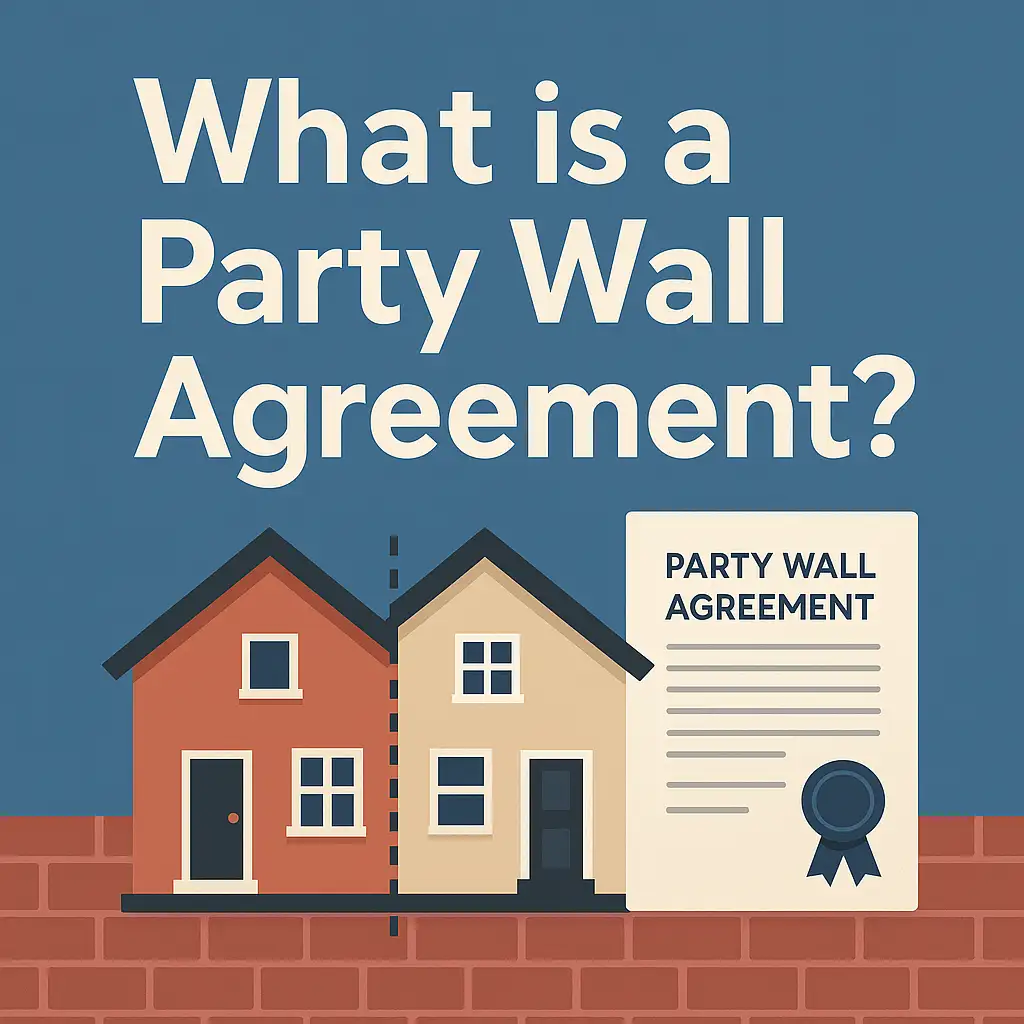
A Party Wall Agreement is the phrase many homeowners use when they need formal permission or statutory protection before carrying out building works that affect a shared wall, boundary, party structure or nearby foundations.
Party Wall Agreement service in London
Need professional help rather than a general explanation?
This article explains the terminology. For help with notices, written neighbour consent, Schedules of Condition and formal Awards, visit our dedicated Party Wall Agreement London service page.
View Party Wall Agreement London serviceStrictly speaking, the Party Wall etc. Act 1996 deals with notices, consents, disputes and Party Wall Awards. In everyday language, however, “Party Wall Agreement” is often used to describe either:
- written consent from an adjoining owner after a valid Party Wall Notice has been served; or
- a formal Party Wall Award prepared by an agreed surveyor or appointed surveyors where consent is not given.
Party Wall Agreement vs Party Wall Award vs Party Wall Notice
This is where many London homeowners get confused. A Party Wall Notice, written neighbour consent and a Party Wall Award are connected, but they are not the same thing.
| Term | What it means | When it applies | Where to go next |
|---|---|---|---|
| Party Wall Notice | The formal written notice served on an adjoining owner before notifiable works begin. | Before works to a party wall, party structure, boundary line or qualifying excavation. | Party Wall Notices London |
| Written consent | The adjoining owner agrees to the notice in writing and does not require surveyor appointments. | Where the neighbour is comfortable with the proposed works after valid notice is served. | Schedule of Condition Surveys |
| Party Wall Award | The formal statutory document prepared by surveyor(s) that authorises how the notifiable works may proceed. | Where the adjoining owner dissents, raises concerns, or does not respond within the required period. | Party Wall Award London |
| Schedule of Condition | A written and photographic record of the adjoining property before works begin. | Often recommended whether the neighbour consents or a full Award is prepared. | Schedule of Condition Survey London |
When do you need neighbour consent or a Party Wall Award?
You may need written consent or a Party Wall Award if your planned works fall within the Party Wall etc. Act 1996. Common London examples include loft conversions, rear extensions, basement excavations, chimney breast removals and structural alterations to shared walls.
- Works to a shared party wall or party structure – for example, inserting steel beams for a loft conversion, cutting into a party wall, removing a chimney breast, raising a party wall or adding structural support. See our Party Wall Structure Survey service.
- Building on or close to the boundary line – such as a new extension wall, garden wall or wall built at the line of junction between properties. See our Party Wall Boundary Survey service.
- Excavations near a neighbour’s structure – including foundations for rear extensions, side returns, basements and deeper excavations within the relevant 3 metre or 6 metre distances. See our Party Wall Excavation Survey service.
- Basement works – basement excavations often involve deeper inspections, temporary works, waterproofing interfaces and more detailed Schedules of Condition. See our Party Wall Survey for Basement Works.
Example: for a terraced-house loft conversion in London, steel beams often need to bear into the party wall. A valid notice should be served before the work begins. If the adjoining owner dissents or does not respond, surveyor appointments and a formal Award will normally be required before notifiable works proceed.
How the process works: from Notice to consent or Award
A Party Wall Agreement is not usually the first step. The process normally starts with serving the correct notice on every relevant adjoining owner.
-
Identify the notifiable works
Drawings, foundations, structural proposals and ownership details are reviewed to confirm whether Section 1, Section 2 or Section 6 notices are required. -
Serve the correct Party Wall Notice
A valid notice is served on the adjoining owner or owners. For professional support, visit our Party Wall Notice service page. -
The adjoining owner responds
The neighbour can consent, dissent and appoint their own surveyor, dissent and agree to use one agreed surveyor, or fail to respond within the required period. -
If there is written consent
A full Party Wall Award may not be needed, but a Schedule of Condition Survey is often recommended before works start. -
If there is dissent or no response
A dispute may be deemed to have arisen and surveyors are appointed to prepare a formal Award controlling how the notifiable works may proceed.
This guide explains the terms. The service page handles the next step.
To avoid confusion, this article is designed as a plain-English guide to the terminology. If you already know you need help with a Party Wall Agreement, notice response, Schedule of Condition or Award, the next step is the dedicated service page.
Professional Party Wall Agreement help in London
Use our service page for appointment options, fee guidance, surveyor support and project-specific advice for London properties.
Visit the Party Wall Agreement London service pageWhat happens if the correct notice, consent or Award is missing?
Starting notifiable works without following the Party Wall process can expose the building owner to avoidable delay, legal cost and neighbour disputes. The correct paperwork should be addressed before the notifiable works begin.
- Injunction risk and project stoppage – an adjoining owner may seek legal action to stop works where notice should have been served.
- Delay to the build programme – invalid or missing notices may mean the statutory process has to start again.
- Damage disputes – without a proper Schedule of Condition, it can be harder to separate pre-existing defects from alleged construction damage.
- Higher overall cost – retrospective advice, legal correspondence, redesign, surveyor disputes and remedial works can cost significantly more than dealing with the process correctly at the start.
- Strained neighbour relationships – a clear, professional process often helps keep communication calm and neighbourly.
If the Party Wall Notice, consent or Award is incorrect
Incorrect paperwork can cause avoidable problems. Common issues include the wrong owner details, missing adjoining owners, incorrect property addresses, unclear works descriptions, incomplete excavation drawings, invalid service dates, or a failure to cover all relevant parts of the Act.
A defective Party Wall Notice may need to be re-served. An unclear Party Wall Award may leave room for arguments about access, working hours, making good damage, temporary protection, security, costs or the precise scope of authorised works.
Using a qualified Party Wall Surveyor helps ensure the notice, Schedule of Condition and Award are prepared correctly and that both the building owner and adjoining owner understand their rights and responsibilities.
Why professional advice helps
- Correct notice strategy – identifying whether Section 1, Section 2, Section 6 or multiple notices are required.
- Clear route to consent or Award – helping homeowners understand whether they need written neighbour consent or a full Party Wall Award.
- Robust Schedule of Condition – a detailed photographic and written record before works begin.
- Dispute prevention – clear communication, properly drafted documents and practical protection measures.
- Time and cost control – reducing the risk of invalid notices, avoidable delays and legal escalation.
For appointment options and project-specific support, use the Party Wall Agreement London service page rather than relying on a general guide alone.
Frequently Asked Questions
Not always. Homeowners often say “Party Wall Agreement” when they mean either written consent from a neighbour or a formal Party Wall Award. If the adjoining owner consents to the notice, a full Award may not be needed. If they dissent or do not respond, an Award is normally required.
A Party Wall Notice is the formal document that starts the process. A Party Wall Agreement is the outcome people usually want: either written consent from the adjoining owner or a Party Wall Award prepared by surveyor(s).
If you need to start the process, visit our Party Wall Notice service page.
You usually need a Party Wall Award where notifiable works are proposed and the adjoining owner dissents, raises concerns, or does not provide written consent within the required period.
See our Party Wall Award London service for more detail.
If the adjoining owner gives valid written consent to the Party Wall Notice, a full Award is usually not required. However, a Schedule of Condition is still strongly recommended so both properties are protected if a damage allegation arises later.
See our Schedule of Condition Surveys London service.
You cannot assume no response means agreement. If the adjoining owner does not respond within the statutory period, the dispute resolution process may begin and surveyor appointments may be required.
This article explains the terminology. For professional help with notices, consent, Schedule of Condition Surveys and Awards, use our dedicated Party Wall Agreement London service page.

Richard Hourican, Company Director
BSc (Hons). HND Build. MCIOB. C.Build E MCABE. ARICS. MFPWS. MPTS
As a specialist Party Wall surveyor, Richard Hourican will protect your interests during building works.
Are you planning a building project – perhaps an extension, loft conversion or basement – that is on or adjacent to your property’s boundary line? Or has a ‘Party Wall’ notice dropped on the doormat informing you of a neighbour’s impending works?
It’s essential to understand all the implications of building plans. If you don’t, it could cost thousands. Our job is to ensure everything is done correctly – and that it doesn’t!
Follow us: